Meet Some Christian Mystics You May Never Have Heard Of
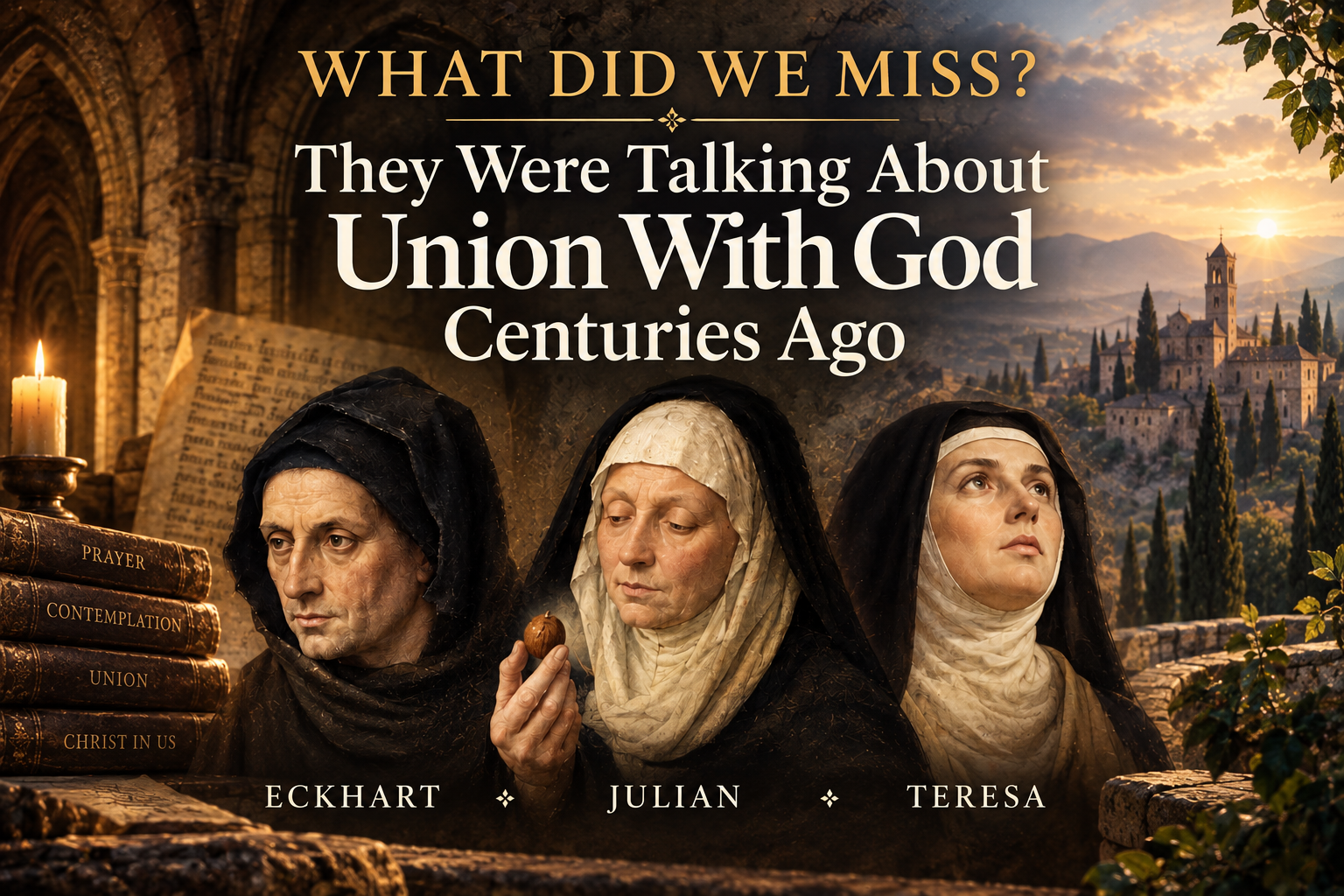
Their names are famous in Christian history, yet many of us barely recognize them: Meister Eckhart. Julian of Norwich. Teresa of Ávila.
They lived in different times and circumstances, but each became known for an extraordinary conviction: God wasn’t merely Someone to believe in from a distance. God could be encountered, experienced and known in profound communion and union.
If that sounds surprisingly contemporary, it should.
Across parts of the Body of Christ today, believers are talking about union with Christ, theosis, participation in the divine nature, the indwelling presence of God, and the Kingdom of God within us. These ideas can sound new—even radical—to Christians who have never encountered them before.
But they aren’t new questions. Christians were wrestling with—and sometimes describing profound experiences of—these realities many centuries ago. Some of the theological roots reach back into the early centuries of Christianity.
So what did we miss?
Were these isolated saints describing unusual experiences reserved for a spiritual few? Or were they exploring dimensions of Christian life that Scripture has been pointing toward all along?
This is an invitation to investigate that possibility. Not to become Catholic or join another denomination, and certainly not to accept everything every mystic ever said. Instead, we’re going to listen to some Christians from the past and ask some fascinating questions.
What Did Jesus Mean by “You in Me, and I in You”?
Before we talk about mystics, consider the words of Jesus:
“In that day you will know that I am in My Father, and you in Me, and I in you.”
— John 14:20
Jesus didn’t merely promise that we would believe certain things about Him. He described an astonishing relationship of indwelling and union.
On the night before His crucifixion, He prayed:
“That they all may be one; as You, Father, are in Me, and I in You…I in them, and You in Me.”
— John 17:21–23
Paul uses equally startling language: “Christ in you, the hope of glory” (Colossians 1:27) and “It is no longer I who live, but Christ lives in me” (Galatians 2:20). Peter says that through God’s promises we become “partakers of the divine nature” (2 Peter 1:4).
These verses are so familiar that we can read right past the extraordinary reality they describe. What exactly have Christians through the centuries thought they meant? And what happens when believers take them seriously enough to seek their experiential reality?
An Ancient Christian Idea With a Strange Name: Theosis
Very early in Christian history, theologians began speaking in remarkably strong terms about humanity’s participation in God’s life. The tradition eventually came to be described by terms such as deification, divinization and theosis.
The word can sound intimidating, but the central idea doesn’t have to be. In simple terms, theosis describes real participation by grace in the life of God.
It does not mean that human beings become God the Creator or lose the distinction between Creator and creature. Rather, God transforms human beings through communion with Himself, enabling them to participate in His divine life.
Peter’s description of believers becoming “partakers of the divine nature” (2 Peter 1:4) became an especially important biblical text for explaining this idea.
Seen through that lens, salvation becomes much larger than believe, behave, die and go to heaven. God does not merely forgive us from a distance. In Christ, God joins Himself to humanity, makes us His dwelling place, transforms us and draws us into participation in His life.
Then passages such as Romans 8, John 17, Ephesians 1 and Colossians 1 begin to look enormous.
This wasn’t invented by twenty-first-century charismatic Christians. The Christian conversation about participation in divine life is ancient.
A Stream of Christian Experience
As Christianity developed, there continued to be men and women who weren’t satisfied merely knowing doctrines about God. They wanted to know God experientially.
Some withdrew into deserts. Others lived in monasteries, convents or ordinary communities. Their writings describe contemplation, transformation, divine Love, indwelling presence, and profound experiences of communion and union with God.
Today we call many of them Christian mystics.
That term needs clarification. Christian mysticism is not automatically occultism, New Age spirituality or an attempt to discover divinity apart from Christ. At its historic Christian center lies a much simpler conviction:
God can actually be known and experienced.
Once we understand that, some people with unfamiliar medieval names suddenly become much more interesting.
Before meeting three of these Christians, it helps to see the larger historical landscape. Filip Holm traces Christian mysticism as a scholar of religion — not from a Catholic, Protestant or contemporary Kingdom perspective — moving from ancient Christianity through its Eastern and Western expressions.
The video runs about an hour. If you don’t have time right now, just keep reading — everything you need is here.
A Wider Historical View
Helpful Study Notes From This Post
Download the companion study notes — a unique feature of Kingdom Conversations posts.
🔗 Open in New Tab📱 Mobile users —
LONG-PRESS the link below for options
Study Notes PDF — What is Christian Mysticism?The essential question is much simpler:
What were these Christians encountering that caused them to speak so persistently about union, indwelling, transformation and divine Love?
Meister Eckhart: What If the Word Is Born Within Us?
Meister Eckhart (c. 1260–1328) was a German Dominican theologian and preacher and remains one of the most provocative Christian thinkers of the Middle Ages.
One of the major themes in Eckhart’s teaching is what scholars call the “birth of the Word in the soul.” His thought here is complex, involving the deepest “ground” of the soul, detachment and receptivity to God’s action. We shouldn’t reduce it too quickly to modern language about “Christ within.”
Julian of Norwich: What If Love Really Wins?
Then there is Julian of Norwich (c. 1343–after 1416). During a severe illness in 1373, Julian experienced a series of visions—or “showings”—that became the basis of her Revelations of Divine Love.
She lived in a world marked by plague, suffering, violence and religious fear. Yet her reflections upon these experiences became overwhelmingly centered upon the goodness and Love of God.
She is famous for the assurance:
“All shall be well, and all shall be well, and all manner of thing shall be well.”
It is easy to turn that into a pleasant inspirational slogan, but Julian’s actual question was much harder. She wrestled with sin, suffering and how God’s goodness can finally make all things well.
One of her most memorable visions involved something tiny, about the size of a hazelnut, resting in her hand. She understood it to represent “all that is made.” She wondered how something so small and fragile could continue to exist.
The answer she perceived was that it endures because God loves it. Julian then summarized three things she understood about creation: God made it, God loves it, and God cares for or preserves it.
That becomes fascinating alongside Paul’s description of Christ: “In Him all things hold together” (Colossians 1:17). Paul also describes creation itself being “delivered from the bondage of corruption into the glorious liberty of the children of God” (Romans 8:21).
We shouldn’t simply turn Julian into a modern universalist or Kingdom teacher. Her theology deserves to be heard in its own setting.
But her question remains compelling:
If God really is Love, what does that tell us about His ultimate purposes for His creation?
Nevertheless, the image creates a fascinating biblical conversation with Paul’s longing:
“My little children, for whom I labor in birth again until Christ is formed in you.”
— Galatians 4:19
Eckhart believed this divine birth required profound detachment from our grasping attachments and self-centered ways of relating to God. Some of his formulations are difficult and controversial, and modern spiritual movements have sometimes detached his words from their specifically Christian context.
That gives us good reason to examine him carefully rather than either embracing or dismissing him.
But underneath the controversy lies an extraordinary question:
What does it actually mean for the life of Christ to become manifest within a human being?
Teresa of Ávila: What If the Journey Is Inward?
About two centuries later, Teresa of Ávila (1515–1582) described the spiritual life using one of Christianity’s most memorable metaphors: the Interior Castle.
Teresa asks us to imagine the soul as a magnificent castle containing many mansions. Significantly, she writes of a mansion at the center of the soul reserved for God Himself.
Her spiritual journey therefore isn’t merely an attempt to reach a distant God somewhere “up there.” It is a journey of prayer and transformation toward increasingly profound communion with God. In the later mansions, Teresa describes what she calls prayer of union and ultimately spiritual marriage, using the language of God uniting the soul to Himself.
That creates an interesting conversation with Paul’s insistence that believers are God’s temple and that His Spirit dwells within them.
Again, we shouldn’t make Teresa say exactly what contemporary Kingdom teachers say. She lived in another century, another theological environment and another religious culture.
But her question is difficult to ignore:
What if some of our spiritual searching for God “out there” prevents us from recognizing the extraordinary implications of the God who has chosen to dwell within us?
Why Does This Sound So Familiar?
Now we arrive at the reason this history becomes especially interesting.
Listen to some of the language appearing in contemporary Kingdom, grace and mystical Christian conversations: union rather than separation, theosis, participation in divine life, Christ in us, inclusion in Christ, the indwelling Kingdom, and experiential communion with Father, Son and Holy Spirit.
Contemporary teachers such as C. Baxter Kruger, John Crowder and Justin Paul Abraham approach these subjects differently, but these themes genuinely appear in their teaching.
Crowder explicitly teaches theosis and humanity’s participation in divine life through Jesus Christ. Kruger’s ministry has for decades emphasized our inclusion in Jesus and His relationship with the Father in the Spirit. Abraham describes mystical union and awareness of our communion with the divine nature as central to his message.
Suddenly the historical mystics become especially interesting.
Meister Eckhart ↔ John Crowder
The birth of the Word in the soul meets theosis and participation in divine life.
Julian of Norwich ↔ C. Baxter Kruger
Confidence in divine Love and God’s sustaining relationship with creation meets humanity’s inclusion in Jesus’ communion with the Father and Spirit.
Teresa of Ávila ↔ Justin Paul Abraham
The Interior Castle and increasingly profound experiential union meet mystical union and awakening to our life in God.
Are they all saying the same thing? No. And that distinction matters.
But are there genuine intersections worth exploring?
Absolutely.
A Stream Running Through Christian History?
Imagine Christian history differently for a moment. Instead of seeing only denominations, institutions and theological disputes, imagine a stream of Christians repeatedly returning to the reality of communion with God.
Jesus and the apostles speak of “You in Me and I in you.”
Early Christian theologians develop increasingly explicit language about participation in divine life.
The Desert Fathers and Mothers pursue prayer and transformation.
Later Christian mystics write extensively about experiential knowledge and union with God.
Then we encounter Eckhart and the birth of the Word in the soul, Julian and creation sustained by divine Love, and Teresa and the Interior Castle. Later contemplative Christians continue emphasizing the experiential presence of God.
Today we again hear Christians talking about union, inclusion, theosis, indwelling and participation.
That raises an intriguing question:
Did the stream ever disappear—or have Christians repeatedly encountered it, lost sight of it, argued about it and encountered it again?
What If the Mystics Weren’t the Exception?
Perhaps this is the most provocative question of all.
We call people such as Teresa, Julian and Eckhart mystics because their experiences seem extraordinary. But what if experiencing communion with God was never intended to be extraordinary Christianity?
What if it was simply intended to be Christianity?
Jesus didn’t pray that a handful of unusually spiritual people would experience union. He prayed, “that they all may be one.”
Paul didn’t write “Christ in you, the hope of glory” only to mystics. Peter didn’t reserve becoming “partakers of the divine nature” for monks and saints.
Maybe the question isn’t why the mystics experienced so much. Maybe the more uncomfortable question is why Christians have sometimes expected so little from the reality of God’s indwelling presence.
An Invitation, Not a Conclusion
This series isn’t intended to canonize the mystics. They were human beings who interpreted their experiences through the cultures, theology and institutions of their times. Some of their conclusions deserve serious questioning.
Neither are we assuming that contemporary Kingdom teachers have everything figured out.
Instead, we’re going to do something more interesting:
Listen. Compare. Test.
We’ll listen to Christians from other centuries, compare what they described with what believers are exploring today, and test these ideas against Scripture and the revelation of God we see in Jesus Christ.
Along the way we’ll explore Meister Eckhart, Julian of Norwich and Teresa of Ávila in greater depth. We’ll also examine their surprising points of intersection—and their important differences—with John Crowder, C. Baxter Kruger and Justin Paul Abraham.
We may discover remarkable continuity. We may encounter important contradictions. And we may discover that some things that sound startlingly new actually have very old Christian roots.
But perhaps the greatest question isn’t historical at all.
It is personal.
Jesus said:
“In that day you will know that I am in My Father, and you in Me, and I in you.”
— John 14:20
What if He meant for us to actually know it?
And what might happen if we did?
Your Turn to Talk!
Let us know what you think.
Before reading this, had you ever heard of Christian mysticism — and does knowing it has deep biblical and historical roots change how you see it?
Which of the three mystics — Meister Eckhart, Julian of Norwich, or Teresa of Ávila — raises the most compelling question for you, and why?
Do you think union with God was meant for a special few — or for every believer? What in your own experience points you in one direction or the other?
Leave a Reply